
1200 Park Central Blvd. South, Pompano Beach, FL 33064
9121 North Military Trail, Suite 200, Palm Beach Gardens, FL 33410
855 E SR 434., Suite 2209, Winter Springs (Orlando area), FL 32708
1211 North Westshore Blvd., Suite 409 Tampa, FL 33607
Offices in Miami-Dade (by appointment)
Reach any office: 800.974.0680

1200 Park Central Blvd. S., Pompano Bch, FL 33064
9121 N. Military Trail, Ste. 200, Palm Bch Gdns, FL 33410
855 E SR 434., Suite 2209, Winter Springs (Orlando area), FL 32708
1211 N. Westshore Blvd., Ste. 409, Tampa, FL 33607
Offices in Miami-Dade (by appointment)
Reach any office: 800.974.0680

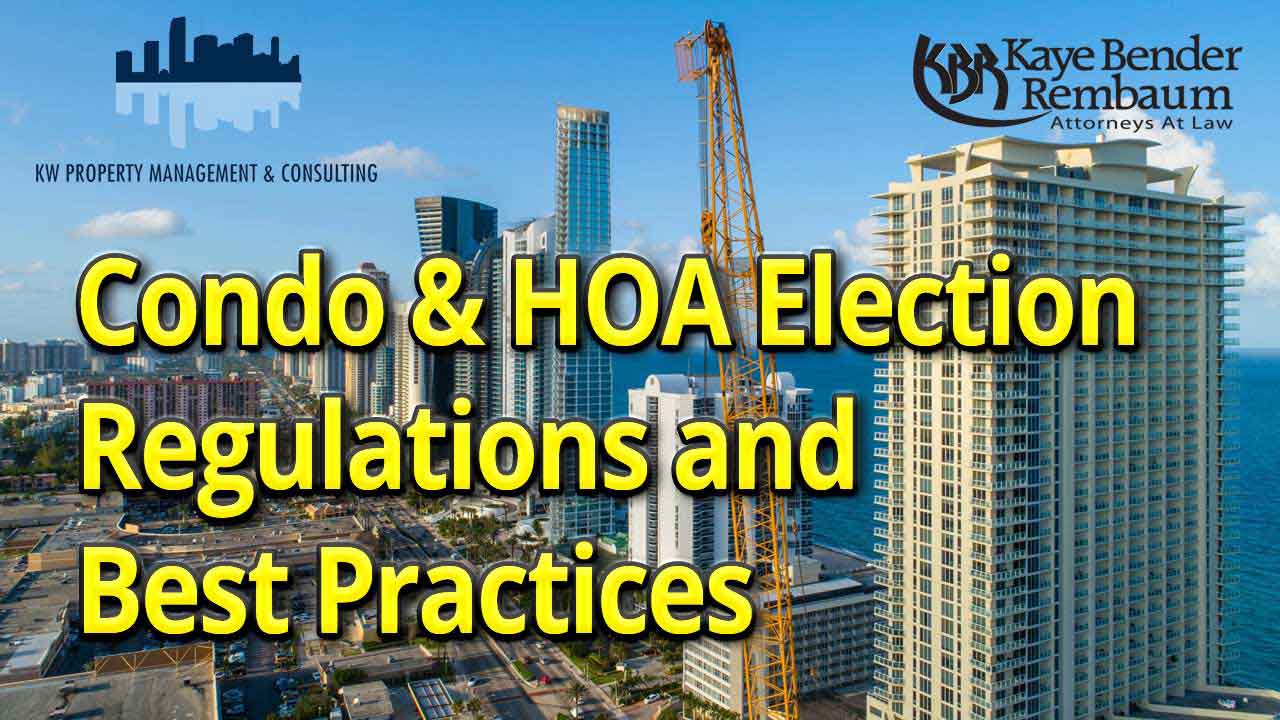
Election Regulations and Best Practices

KWPMC Executive Director Tim O’Keefe interviewed association attorneys Michael S. Bender and Andrew B. Black from the firm Kaye Bender Rembaum and Zuly Maribona, Senior Vice President at KWPMC, who provided insights about the Florida regulations surrounding board elections and best practices around how to plan, schedule and conduct an effective election.

Will The Association’s Denial Of An Architectural Request Withstand Challenge? Many Won’t—Find Out Why

Rembaum's Association Roundup | Jeffrey A. Rembaum, Esq., BCS

For many homeowners associations, a top priority is ensuring that the homes in the community are maintained in conformity with the “community-wide standard.” But, what is this subjective standard? How is compliance measured? What is the process to be judged when a request to the association’s architectural review committee (ARC) is made? The ARC is instrumental in ensuring that the community-wide standard is met. However, your association may run into a problem if the ARC denies a request from a homeowner if the association has not adopted specific, objective criteria and guidelines on which the ARC can rely.

[Read the Full Article…]

HOALeader.com – Tip of the Week – February 4, 2022

HOALeader.com is a paid membership organization. The following tip is a summary of the full article on their website, which requires a membership to view. A link to HOALeader.com appears at the end of the tip. This tip features quotes from KBR Legal’s Lisa A. Magill, Esq.

In this week’s tip, we discuss the maintenance and inspection requirements recommended in a new report issued by a grand jury seeking to prevent a repeat of the collapse of the Champlain Towers South condo in Surfside, Fla.

Many of the grand jury’s suggestions are specific to Florida law, but some could be adopted in other states. Among those are:

* Requiring board members to certify that they’ve had regular and routine maintenance of all components affecting the structural integrity of the building within the past 12 months

* Creating a new specific duty of inspection to be imposed on board members, including that inspections and repairs be performed every 10 years

Could those recommendations be adopted in Florida, and do they even make sense for other condo boards nationwide?

Since Surfside, Lisa Magill, of counsel based in Pompano Beach, Fla., Kaye, Bender & Rembaum, has been involved in industry efforts to evaluate ways to strengthen building maintenance and structural integrity among communities nationwide. She was familiar with Champlain Towers South before it collapsed and recalls it as a desirable property among oceanfront condos in the area.

Magill believes the threshold problem in the community association industry is that many—the vast majority, she says—unit owners aren’t aware of the true costs of ownership in a property in a multifamily community. “A complete change of mindset is required,” she asserts.

“There are nine states that require homeowner-led associations to obtain reserve studies and five that impose this obligation on developer-controlled communities,” explains Magill. “Florida is behind the curve in my opinion in many respects. While the law requires condo and cooperative association boards to adopt a budget containing a funded reserve schedule, there’s no present requirement for an independent analysis to create the schedule.

“Moreover, Florida law permits owners to waive reserve funding altogether by a vote of the membership” she adds. “Purchasers shouldn’t be permitted to base their financial projections or assess affordability of the property on a current budget that doesn’t include reserve or other funding for necessary maintenance and repair of the buildings and improvements.

“Owners need to pay to remedy the deterioration of the property as it deteriorates,” says Magill. “And community leaders need mandated guidelines and standards to curb the desire to ‘cut corners’ or to perform patch repairs.

“I think the blame is on both sides,” she states. “Boards are owners, too. They’re either pressured or feel pressured to keep fees as low or as steady as they can. Plus, they’re pressured to engage in activities that are visibly appreciable by owners, such as updating lobbies.”

But some of our experts think the focus on reserve studies and reserve funding doesn’t capture the entire problem. Find out why, and learn what kind of new legislation, in Florida and across the country, is likely to result, in our new article:

https://www.hoaleader.com/members/4460.cfm

Best regards,
Matt Humphrey
President, HOALeader.com

Aging Infrastructure | Knowing What’s at Stake

In this webinar, we discuss common challenges with aging infrastructure, the differences between reserve studies and engineering reports, best practices, as well as current and proposed legislation. Features Lisa A. Magill, Esq., BCS from Kaye Bender Rembaum.

You can CLICK HERE to download and save the slides from the presentation.

Note: Viewing this video on-demand does not offer CE-credit, nor satisfy any requirements for licensed CAMS and Board Members.

HOA Board Member Update

Informational recording from Kaye Bender Rembaum’s HOA Board Member Certification Course. Danielle M. Brennan, Esq., BCS leads this webinar.

Note: Viewing this video on-demand does not offer CE-credit, nor satisfy any requirements for licensed CAMS and Board Members.

Elections | Condominium, Cooperative and Homeowners’ Associations

Join attorney Allison L. Hertz for a one-hour webinar addressing election law and procedures for condominiums, cooperatives and homeowners’ associations, including eligibility requirements and terms of directors, best practices for remote meetings, vacancies between elections, and election disputes.

Note: Viewing this video on-demand does not offer CE-credit, nor satisfy any requirements for licensed CAMS and Board Members.

Securing Your Gated Community | Exactly Who is Allowed In?

Rembaum's Association Roundup | Jeffrey A. Rembaum, Esq., BCS

While living in a gated community can add peace of mind for the residents who live behind the gates, there are many important considerations for the association when crafting rules and regulations regarding who may and who may not be permitted to enter the community. In today’s gated communities, there are three entry control options: (i) live personnel to monitor the gate, (ii) a virtual gate guard where the gate guard who allows guests to pass through is off-site and monitoring electronically, or (iii) a simple call box.

Many associations adopt rules which require visitors to the community to present valid identification to ensure that the visitors are authorized by the association or a resident to enter the community. But, what kind of identification can an association require? Are there limits? In the end, the association must…[Read the full article]

Deconstructing the Construction Contract | A Plain English Explanation

Rembaum's Association Roundup | Jeffrey A. Rembaum, Esq., BCS

If your community association has engaged the services of a contractor, engineer, architect, or other construction or design professional to perform a maintenance, repair, replacement, or capital improvement project, you know the process can be overwhelming. No matter the mad rush to execute the contract as soon as possible, when beginning such projects, no matter how big or small, the board needs to ensure the contract adequately protects the association. Even the smallest of projects can have unexpected, disastrous consequences. A few of the more common provisions which every board member should understand follow. [Read the Full Article]