
1200 Park Central Blvd. South, Pompano Beach, FL 33064
9121 North Military Trail, Suite 200, Palm Beach Gardens, FL 33410
855 E SR 434., Suite 2209, Winter Springs (Orlando area), FL 32708
1211 North Westshore Blvd., Suite 409 Tampa, FL 33607
Offices in Miami-Dade (by appointment)
Reach any office: 800.974.0680

1200 Park Central Blvd. S., Pompano Bch, FL 33064
9121 N. Military Trail, Ste. 200, Palm Bch Gdns, FL 33410
855 E SR 434., Suite 2209, Winter Springs (Orlando area), FL 32708
1211 N. Westshore Blvd., Ste. 409, Tampa, FL 33607
Offices in Miami-Dade (by appointment)
Reach any office: 800.974.0680

When Directors’ and Officers’ Insurance Isn’t What You Think It Is

Rembaum’s Association Roundup | Jeffrey A. Rembaum, Esq., BCS | Visit HERE

When Directors’ and Officers’ Insurance Isn’t What You Think It Is | A Wake-up Call for Community Association Board Members

Over the last several months, I have encountered several situations in which condominium and homeowners’ association board members were shocked to learn the true nature of the directors’ and officers’ liability coverage they believed was designed to protect them. In each case volunteer board members were named individually in lawsuits filed by dissatisfied owners. Little did they know that after the claims were made, they discovered that the policy they had relied upon did not provide the broad protection they assumed existed.

These board members believed they had purchased traditional directors’ and officers’ liability insurance. Instead, they learned that the policy functioned more like a limited legal defense program than a comprehensive liability policy. The distinction can be significant. When a board member is sued, the expectation is often that the insurance company will not only provide a legal defense but may also cover litigation-related expenses and, when appropriate, pay settlements or judgments. Yet many policies contain extensive limitations, exclusions, conditions, and reimbursement obligations that can dramatically restrict coverage.

Read the full article HERE
Importance of Having Strong Financial Controls and Policies

Rembaum’s Association Roundup | Jeffrey A. Rembaum, Esq., BCS | Visit HERE

Importance of Having Strong Financial Controls and Policies

Florida’s community associations operate as complex financial and administrative organizations responsible for managing significant budgets, often in the millions of dollars; maintaining shared property; and protecting the financial interests of the owners. With this responsibility comes a board’s fiduciary duty to ensure that financial operations are transparent, accountable, and safeguarded against misuse. In today’s environment where associations face rising costs, increased owner scrutiny, and growing exposure to fraud risks, the need for strong financial policies and controls has never been more important. These four tools form the foundation of responsible financial governance:

i.   A fraud response plan
ii.  A refundable deposit return policy
iii. A conservative reserve investment policy
iv. 
Internal control procedures that guide how the association handles money, assets, and decision-making.

These tools are not merely administrative “housekeeping” items; they are essential safeguards that protect the association’s finances, support the board’s fiduciary obligations, and reinforce trust within the community.

Read the full article HERE

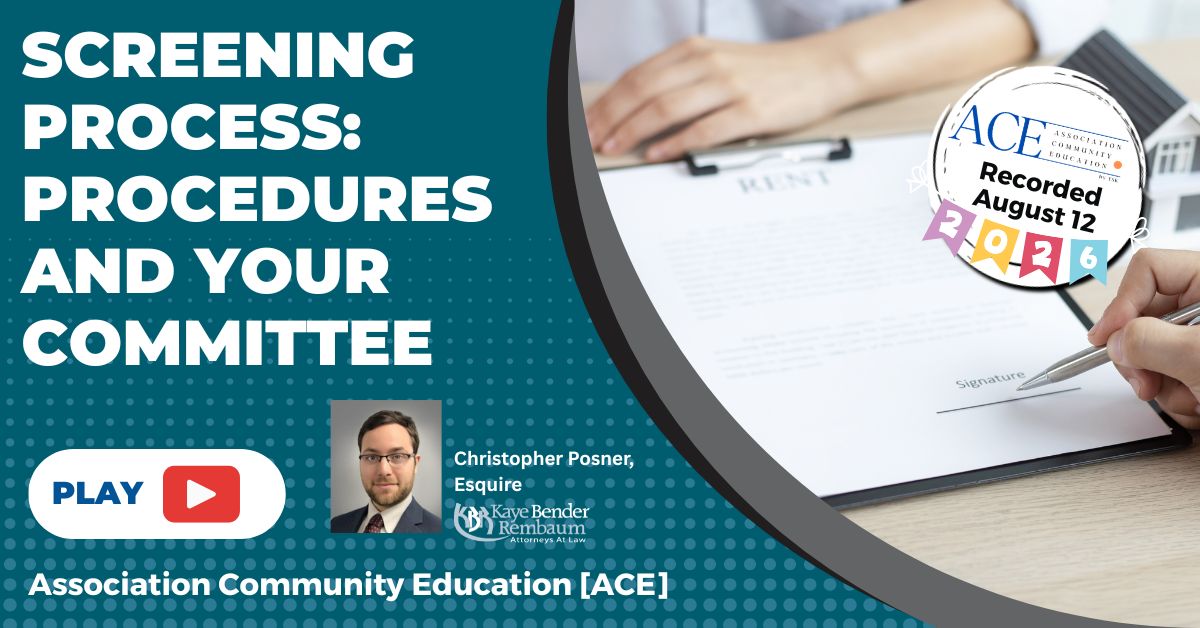
The Screening Process: Developing Procedures and Training Your Committee | August 12, 2026

*Read Before Viewing* | This recorded video WILL NOT satisfy Florida state certification requirements for Board Members, NOR will this recorded version offer CEUs for CAMS or Board Members. It is for informational purposes only and is not to be considered as legal advice. Should you have any questions, contact your association counsel.

Led by Christopher Posner, Esq. of Kaye Bender Rembaum. A comprehensive education centered around approvals for sales and leases, and how having clearly defined procedures for handling them will help to prevent liability exposure for the corporation (association), individual board members and community association managers.

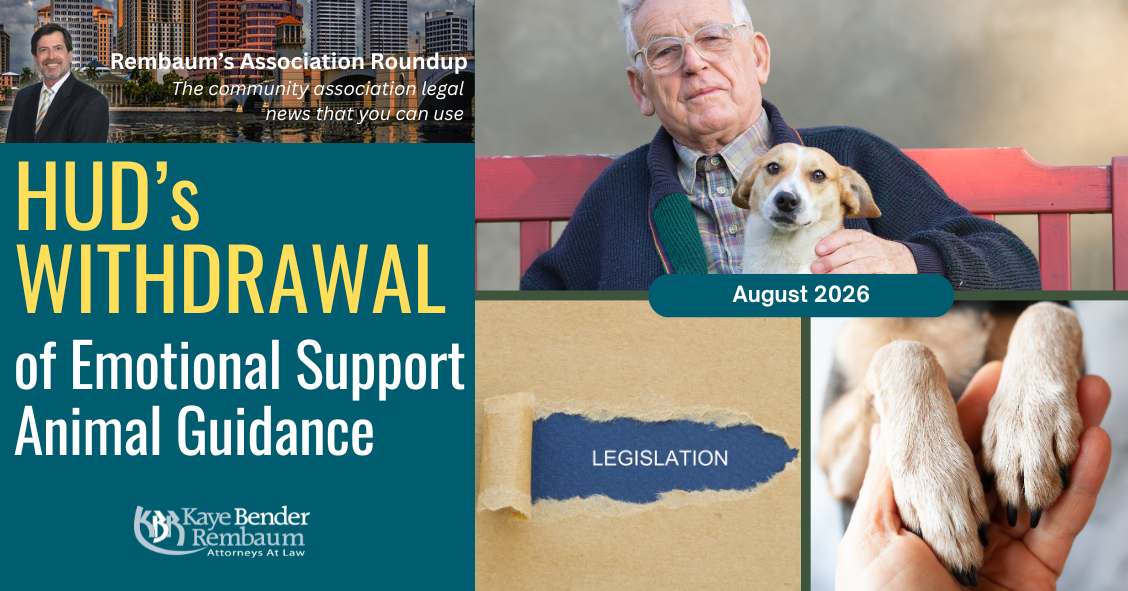
HUD’s Withdrawal of Emotional Support Animal Guidance

Rembaum’s Association Roundup | Jeffrey A. Rembaum, Esq., BCS | Visit HERE

HUD’s Withdrawal of Emotional Support Animal Guidance

For years condominium and homeowners’ associations confronting requests for emotional support animals (ESAs) operated under a relatively well-defined framework established by the U.S. Department of Housing and Urban Development (HUD). The agency’s 2020 guidance, Assessing a Person’s Request to Have an Animal as a Reasonable Accommodation Under the Fair Housing Act, became the primary roadmap for evaluating ESA requests and was frequently cited by attorneys, housing providers, administrative agencies, and courts.

That landscape changed dramatically in May 2026 when HUD’s Office of Fair Housing and Equal Opportunity (FHEO) formally withdrew the 2020 guidance and announced a significant shift in enforcement priorities. At roughly the same time, HUD withdrew numerous prior guidance documents and advisory materials, explaining that guidance documents should not be treated as binding law and should not impose compliance obligations beyond those found in statutes, regulations, and binding judicial precedent.

Read the full article HERE

HOA Financial Literacy and Transparency | July 29, 2026

*Read Before Viewing* | This recorded video WILL NOT satisfy Florida state certification requirements for Board Members, NOR will this recorded version offer CEUs for CAMS or Board Members. It is for informational purposes only and is not to be considered as legal advice. Should you have any questions, contact your association counsel.

Course led by attorney Kerstin Henze, Esq.
 
A comprehensive view of the statutory requirements for financial operations and financial transparency. At the end of the course the students will be able to demonstrate (a) their obligations to maintain and allow access to financial records, (b) year-end financial reporting requirements, (c) restrictions against use of debit cards and criminal penalties for improper use, (d) requirements to furnish parcel owners with an accounting upon request, (e) budgeting and collection of assessments, (f) criminal penalties for kickbacks and other wrongful acts, and (g) conflict disclosures.

HOA Record Keeping and Records Access | July 21, 2026

*Read Before Viewing* | This recorded video WILL NOT satisfy Florida state certification requirements for Board Members, NOR will this recorded version offer CEUs for CAMS or Board Members. It is for informational purposes only and is not to be considered as legal advice. Should you have any questions, contact your association counsel.

Course led by attorney Kerstin Henze, Esq. 
 
A comprehensive view of a homeowners’ association’s and Community Association Manager’s (CAM’s) responsibility to obtain, maintain and allow access to official records, the obligation to create and upload documents to a website or other online forum and penalties applicable to CAMs and Board Members for violating the law.

Condominium Board Member Certification | July 17, 2026

*Read Before Viewing* | This recorded video WILL NOT satisfy Florida state certification requirements for Board Members, NOR will this recorded version offer CEUs for CAMS or Board Members. It is for informational purposes only and is not to be considered as legal advice. Should you have any questions, contact your association counsel.

Course led by attorneys Danielle M. Brennan, Esq. BCS and Andrew B. Black, Esq. BCS. 
 
A comprehensive education of the statutory requirements and responsibilities that each volunteer must know to more effectively serve on the Board of Directors of a Condominium Association.

HOA Meetings, Notices, Participation, Voting and Elections | July 8, 2026

*Read Before Viewing* | This recorded video WILL NOT satisfy Florida state certification requirements for Board Members, NOR will this recorded version offer CEUs for CAMS or Board Members. It is for informational purposes only and is not to be considered as legal advice. Should you have any questions, contact your association counsel.

Course led by attorney Kerstin Henze, Esq. 
 
Covering the types of meetings held by Homeowners’ Associations such as meetings of the board of directors, membership meetings (including the annual meeting) and special meetings, explaining notice requirements for each type of meeting and member participation rights, member rights to petition for a special meeting, and voting thresholds/timelines for various actions.

Understanding Responsibility for Hurricane Protection Removal and Reinstallation Under Florida’s Condominium Act

Rembaum’s Association Roundup | Jeffrey A. Rembaum, Esq., BCS | Visit HERE

Understanding Responsibility for Hurricane Protection Removal and Reinstallation Under Florida’s Condominium Act

As I write this, Florida’s hurricane season is only a few days away. Not too long ago the Florida legislature amended Section 718.113(5)(d) of the Florida Statutes, and the change has significant financial implications for condominium associations and unit owners. This statute now directly addresses who must pay for the removal and reinstallation of hurricane protection such as shutters, impact windows, doors, and similar systems when that removal is necessary for the association to perform work on the common elements. This article addresses both who pays for the removal and reinstallation and who performs the work to do so.

The relevant statute provides that unless the declaration of condominium expressly provides otherwise, a unit owner is not responsible for the cost of removing or reinstalling hurricane protection when the association must temporarily remove it to complete maintenance, repair, or replacement of condominium property for which the association is responsible. This means that the default rule under the amended statute is that the association bears the cost of removal and reinstallation of hurricane protection. This could be a major shift for many communities, especially those with older declarations that never contemplated modern hurricane protection systems. Removal and reinstallation can be very expensive, particularly for impact-rated shutters and windows, and the cost can multiply quickly during large-scale projects such as concrete restoration, painting, balcony work, or window replacement.

Read the full article HERE