1200 Park Central Blvd. South, Pompano Beach, FL 33064
9121 North Military Trail, Suite 200, Palm Beach Gardens, FL 33410
855 E SR 434., Suite 2209, Winter Springs (Orlando area), FL 32708
1211 North Westshore Blvd., Suite 409 Tampa, FL 33607
Offices in Miami-Dade (by appointment)
Reach any office: 800.974.0680

1200 Park Central Blvd. S., Pompano Bch, FL 33064
9121 N. Military Trail, Ste. 200, Palm Bch Gdns, FL 33410
855 E SR 434., Suite 2209, Winter Springs (Orlando area), FL 32708
1211 N. Westshore Blvd., Ste. 409, Tampa, FL 33607
Offices in Miami-Dade (by appointment)
Reach any office: 800.974.0680

Audio and Video Recording in Community Associations

Rembaum’s Association Roundup | Jeffrey A. Rembaum, Esq., BCS | Visit HERE

Audio and Video Recording in Community Associations

Community associations increasingly rely on surveillance technology to enhance safety and protect property. Cameras with imbedded microphones are everywhere these days. As systems become more sophisticated, many boards are considering or are already using audio-enabled cameras in common areas. However, in Florida, recording spoken conversations raises significant legal considerations. This is especially true in areas where a reasonable person would think their conversations are private. Associations must navigate stringent consent laws, privacy expectations, and specific notification requirements to remain compliant and avoid liability. This article summarizes Florida’s legal framework governing audio recordings and outlines best practices for boards seeking to implement or update their surveillance programs.

Florida is a two-party consent state, meaning that all parties to a private conversation must consent before they can legally be recorded. This rule applies to in-person, telephone, and electronic communications. Florida Statute §934.03(1)(d) is explicit and specifically states: “It is lawful…for a person to intercept a wire, oral, or electronic communication when all of the parties to the communication have given prior consent.” Because audio recording captures oral communication, compliance with this statute is essential. Failure to obtain proper consent can expose the association to civil and criminal liability…

Read the full article HERE

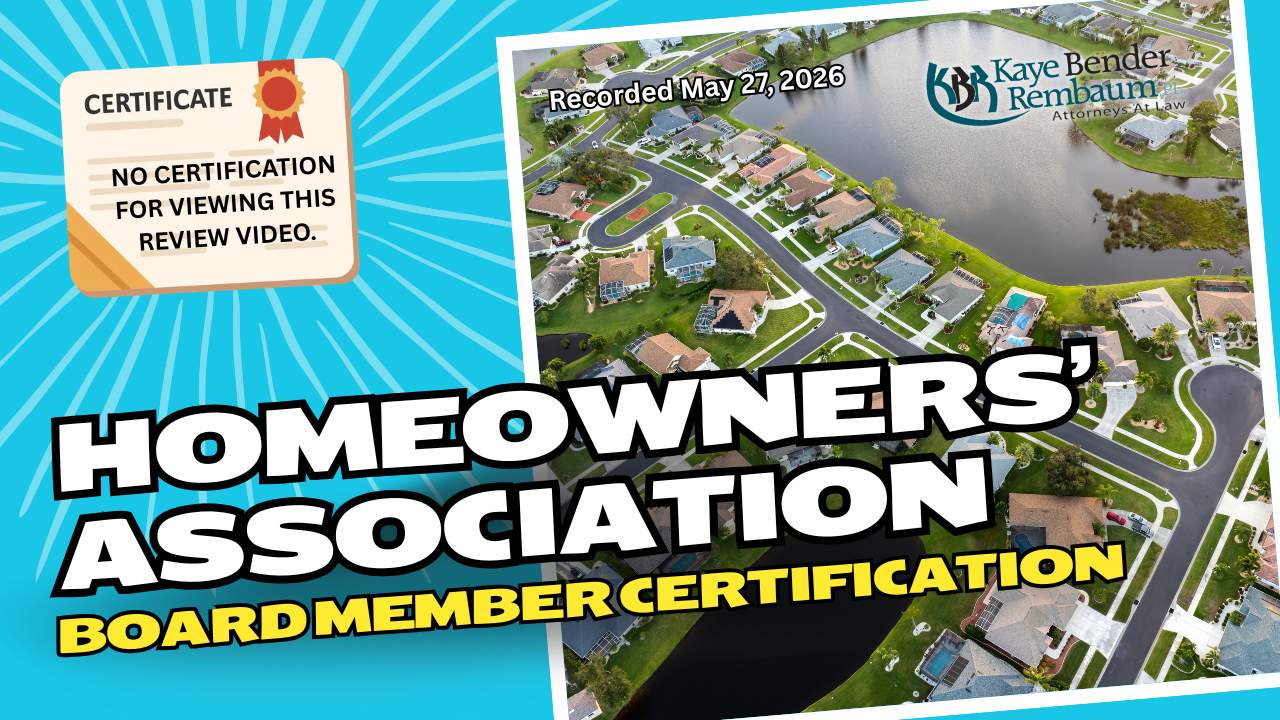
HOA Board Member Certification | April 17, 2026

*Read Before Viewing* | This recorded video WILL NOT satisfy Florida state certification requirements for Board Members, NOR will this recorded version offer CEUs for CAMS or Board Members. It is for informational purposes only and is not to be considered as legal advice. Should you have any questions, contact your association counsel.
Course led by attorneys Peter C. Mollengarden, Esq. BCS and Danielle M. Brennan, Esq. BCS. 
 
A comprehensive education of the statutory requirements and responsibilities that each volunteer must know to more effectively serve on the Board of Directors of a Homeowners’ Association.

Beauty Is in the Eye of the Beholder, or Is It?

Rembaum’s Association Roundup | Jeffrey A. Rembaum, Esq., BCS | Visit HERE

Legal Considerations in Association Landscaping Decisions

It is often said that beauty is in the eye of the beholder, and nowhere is this more evident than in the realm of community landscaping. Among the many benefits of residing within a community association is the expectation of consistently maintained and harmonious landscaping throughout the property. But, when does a change in common area/element landscaping become a material alteration requiring a vote of the membership?

As a general rule for a Florida condominium association, pursuant to §718.113 Fla. Stat., material alterations or substantial additions to condominium common elements require approval by 75 percent of total voting interests unless the declaration of condominium dictates a different procedure. But, as applied to a Florida homeowners’ association, the outcome is diametrically opposed because material alteration decisions are left to the board unless otherwise required by the governing documents.

Read the full article HERE

The Importance of Updating the Governing Documents of Community Associations | Recorded March 27, 2026

Recorded: March 27, 2026
*Read Before Viewing* | This recorded video WILL NOT satisfy Florida state certification requirements for Board Members, NOR will this recorded version offer CEUs for CAMS or Board Members. It is for informational purposes only and is not to be considered as legal advice. Should you have any questions, contact your association counsel.
Statutory changes and case law decisions greatly impact the interpretation, enforceability and legal effect of the governing documents of a community association. Antiquated documents can create liability exposure to the association and its members. Old provisions may hinder association operations, leaving community associations without the rights and remedies it needs to property govern the community. Learn about common pitfalls in older governing documents, specific provisions that are no longer legally enforceable and why updates are so crucial to successful association governance. With Emily E. Gannon, Esq.

Covenant Enforceability for Community Associations | Recorded March 26, 2026

*Read Before Viewing* | This recorded video WILL NOT satisfy Florida state certification requirements for Board Members, NOR will this recorded version offer CEUs for CAMS or Board Members. It is for informational purposes only and is not to be considered as legal advice. Should you have any questions, contact your association counsel.
An informative webinar where we explored the importance of timely and uniform covenant enforcement, and the challenges that may arise due to inconsistent or delayed action. This session is ideal for CAMs, board members, and property professionals seeking to strengthen their understanding of the topic. Led by Kerstin Henze, Esq. of Kaye Bender Rembaum; hosted by CopperDoor Management.

Why Timing and Experience Matter: Lessons from a Recent Appellate Case

Rembaum’s Association Roundup | Jeffrey A. Rembaum, Esq., BCS | Visit HERE

A recent appellate case, Whitehall at Bal Harbour Condominium Ass’n, Inc. v. Raviv, case No. 3D24-2031 (3d DCA, Jan 21, 2026), is a great reminder that in litigation, silence is not golden and can lead to a courtroom disaster. Legal disputes often turn on complex facts, nuanced statutes, and competing interpretations of precedent. But sometimes, the decisive factor is far simpler, such as whether a party raised its legal argument(s) at the right time.

This recent decision is a textbook example of how failing to timely assert a procedural objection can effectively forfeit it, and how that forfeiture can shape the outcome of an entire appeal, leading to a windfall victory for the other side. This case is much more than just a condominium dispute. It is a cautionary tale about litigation strategy, procedural diligence, and the indispensable value of retaining skilled litigation counsel.

The underlying dispute began as a typical conflict between a condominium association (Whitehall) and a…

Read the full article HERE

HOA Board Member Certification | March 4, 2026

*Read Before Viewing* | This recorded video WILL NOT satisfy Florida state certification requirements for Board Members, NOR will this recorded version offer CEUs for CAMS or Board Members. It is for informational purposes only and is not to be considered as legal advice. Should you have any questions, contact your association counsel.
Co-hosted with Folio Association Management. Course led by attorney Alan Schwartzseid, Esq. BCS. 
 
A comprehensive education of the statutory requirements and responsibilities that each volunteer must know to more effectively serve on the Board of Directors of a Homeowners’ Association.

The Importance of Updating the Governing Documents of Community Associations | Recorded February 27, 2026

*Read Before Viewing* | This recorded video WILL NOT satisfy Florida state certification requirements for Board Members, NOR will this recorded version offer CEUs for CAMS or Board Members. It is for informational purposes only and is not to be considered as legal advice. Should you have any questions, contact your association counsel.
Statutory changes and case law decisions greatly impact the interpretation, enforceability and legal effect of the governing documents of a community association. Antiquated documents can create liability exposure to the association and its members. Old provisions may hinder association operations, leaving community associations without the rights and remedies it needs to property govern the community. Learn about common pitfalls in older governing documents, specific provisions that are no longer legally enforceable and why updates are so crucial to successful association governance. With Emily E. Gannon, Esq.

Elections for Community Associations | Recorded February 25, 2026

*Read Before Viewing* | This recorded video WILL NOT satisfy Florida state certification requirements for Board Members, NOR will this recorded version offer CEUs for CAMS or Board Members. It is for informational purposes only and is not to be considered as legal advice. Should you have any questions, contact your association counsel.
Elections for Community Associations (with Kerstin Henze, Esq.). Attendees will learn about about election law and procedures for condominiums, cooperatives and homeowners’ associations, including eligibility requirements and terms of directors, best practices for remote meetings, vacancies between elections, and election disputes.

HOA Board Member Certification | February 20, 2026

*Read Before Viewing* | This recorded video WILL NOT satisfy Florida state certification requirements for Board Members, NOR will this recorded version offer CEUs for CAMS or Board Members. It is for informational purposes only and is not to be considered as legal advice. Should you have any questions, contact your association counsel.
Led by attorney Peter C. Mollengarden, Esq. BCS. 
 
A comprehensive education of the statutory requirements and responsibilities that each volunteer must know to more effectively serve on the Board of Directors of a Homeowners’ Association.