New Legislation Needed for Required Maintenance Affecting Condominium Building Structural Integrity and Safety
Rembaum’s Association Roundup | Jeffrey A. Rembaum, Esq., BCS | Visit HERE
Material Alterations, Special Assessments, and Borrowing
As to the title of this article, anyone familiar with Senate Bill 4-D and the newly required milestone inspection reports and structural integrity reserve studies primarily applicable to condominium and cooperative buildings three stories and higher knows that material alterations, special assessments, and the authority to borrow funds are not mentioned in the legislation. So why write this article about those subjects? Because the milestone reports and structural integrity reserve studies will no doubt also lead to both expected and unexpected required repairs and replacements. In effectuating such repairs and replacements, an association’s board of directors needs i) the ability to approve material alterations under certain circumstances that sometimes arise in connection with such work, ii) the ability to levy special assessments to pay for the work, and iii) the authority to borrow money that is often needed to pay for such repairs and replacements so that the special assessment payments can be amortized over time, thereby lessening the financial strain on the owners.
Navigating the FFHA – Assistance Animal or Pet? | Dec. 13, 2022
Recorded December 13, 2022. Learn about HUD regulations and Florida Legislation pertaining to assistance animals, as well as common issues concerning assistance animals and addressing requests by residents for reasonable accommodations
ACE by TSK hosted and Kaye Bender Rembaum presented. Note: this video is for informational purposes only, and viewing on-demand does not satisfy any Florida state CEU requirements for community association managers. Content should not be considered legal advice.
E-Voting and Elections | December 7, 2022
Castle Group CFO Craig Vaughan hosts the webinar. He was joined by attorneys Jeffrey A. Rembaum & Michael S. Bender – Kaye Bender Rembaum, P.L., each Board Certified Specialists in Condominium and Planned Development Law, and special guest Ben Zelikovitz, GetQuorum, Co-founder.
Note: Viewing this class will not satisfy any Florida State requirement for CAMs or Board Members. This is strictly informational and for review.

Federal Court Identifies Potential Collection Issue for Community Associations in Florida
Community association operations rely upon the timely and full payment of all assessments by all of the owners. One of the mechanisms that Florida law provides to put associations in a stronger position when an owner becomes delinquent is the “secured interest” of the association in the unpaid assessments by way of its ongoing lien against the unit or lot for the unpaid assessments. This secured interest puts the claim of the association at a higher priority than most other claims, other than a first mortgage or unpaid property taxes. However, a recent decision in the United States Bankruptcy Court for the Southern District of Florida, In re: Adam, Case No.: 22-10140-MAM, September 23, 2022, has cast a potential cloud on that secured interest.
In the In re Adam case, the Association previously obtained a judgment of foreclosure for over $76,000, which was considered as a secured interest by the Court. The Association was also claiming an additional $36,558 which came due after the judgment was entered. The owners were asking the Court to decide that the $36,000 was not secured and therefore uncollectible in the bankruptcy (or at least not fully collectible).
In deciding whether certain association claims were secured and collectible in the bankruptcy setting, the Court undertook an analysis of Florida law on the subject. The Court noted that both the Florida Condominium Act (Chapter 718 F.S.) and the Homeowner’s Association Act (Chapter 720 F.S.) currently contain express provisions that identify that the lien of the association is effective from the original recording of the declaration (with the added requirement in HOA’s that the declaration specifically expresses this lien right). However, the Court also points out that the Condominium Act was amended in 1992 to provide for this effective date. (The Homeowner’s Association Act was amended to provide for it in 2008.) Prior to these amendments, these Statutes provided for the effective date of the lien to be when it was recorded in the public records of the county. The analysis of the Court required it to consider whether the current version of the Statute applies to the situation or whether an earlier version of the Statute is the controlling authority. (This case involved a condominium so only the Condominium Act was considered in the decision.)
To make that determination, the Court applied the principles of the seminal case of Kaufman v. Shere, 347 So.2d 627 (Fla. 3d DCA 1977), which require declarations to contain the specific phrase “as amended from time to time” when identifying the Statute that governs the documents in order for the current version of the Statute to apply. This is because Statutes are not retroactive in their application unless the legislature expressly makes them so in the Statute itself. Both the U.S. and Florida Constitutions do not allow for the State to make a law that infringes upon the vested rights in an existing contract (which would be the declaration). As a result, the contract (declaration) would need to have the specific “as amended from time to time” language (often called “Kaufman” language) to automatically incorporate changes to the Statute that is not otherwise retroactive.
When the Court reviewed the governing documents, it noted that they were from 1987 and did not have the Kaufman language. As such, the Court held that the provisions of the declaration were the same as the Statute in 1987, which provided that the lien was effective only upon being recorded in the public records of the county. Since the Association did not file another lien for the amount being claimed subsequent to the foreclosure judgment, the Court concluded that this portion was not secured. In the bankruptcy setting, this meant that the Association would likely be unable to recover most, if not all of this claim from the Debtors, Mr. and Ms. Adam.
While this issue may be most relevant to associations when dealing with a case in bankruptcy, it is possible that it could also be raised in state court foreclosure cases under certain circumstances. It is also important to note that this Bankruptcy Court did not include a significant issue in the analysis regarding the Statute at issue, that being whether or not the statutory provision was “substantive” or “procedural”, as those terms apply to this situation, which could have led to a different result. (This portion of the legal analysis is quite technical and beyond the scope of this article.)
For communities whose declarations were recorded prior to the statutory changes described above, the first step in protecting the interests of the association is to review the documents to determine whether Kaufman language is already in them. If not, the board may wish to consider proposing an amendment to the owners to change the documents to include this language, if not for the entire declaration, then at least for the timing of the effectiveness of the lien of the association. Having qualified legal counsel review these issues in the documents is a strong business practice.
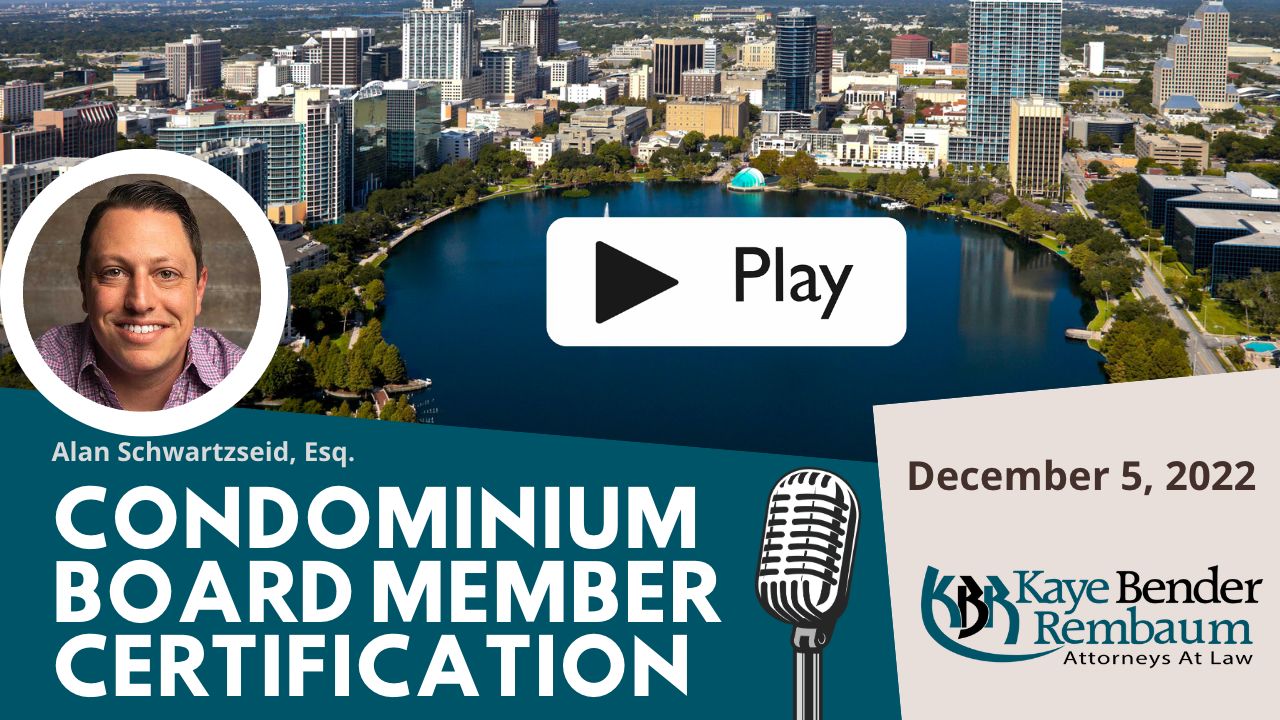
Condominium Board Member Certification | December 5, 2022
This webinar covers the essentials of Condominium board membership, and is updated regularly to remain current with Florida legislative amendments. In addition, when attended live, this webinar satisfies Florida’s requirement for new Condo board members. It also serves as an excellent refresher course. Recorded December 5, 2022. Instructor Alan Schwartzseid, Esq. from KBR’s Orlando, Florida location.
Note: Viewing this class will not satisfy any Florida State requirement for CAMs or Board Members. This is strictly informational and for review.
Senate Bill 4-D Glitches That Must Be Addressed
Rembaum’s Association Roundup | Jeffrey A. Rembaum, Esq., BCS | Visit HERE
Despite the Florida legislature’s best efforts, there nevertheless remains confusion with the interpretation of Senate Bill 4-D (SB 4-D), which provides for condominium and cooperative milestone inspections and structural integrity reserve studies. The purpose of this article is to draw attention to many of these glitches in hopes that the 2023 Florida legislature will address these issues by passing a glitch bill to provide needed and worthwhile clarity for Florida’s community association board members affected by this game-changing legislation. First, a couple of glitches applying to the entirety of SB 4-D are addressed, followed by the glitches related to the required milestone report, and then glitches related to the structural integrity reserve study requirements are addressed. This article does not go into detail explaining the requirements of SB 4-D as that was the subject of a prior article from August 2022 FLCAJ, which can be easily found and read HERE.
Kaye Bender Rembaum on ‘Ask the Experts’ | December 1, 2022
This edition features attorney Robert L. Kaye (Pompano Beach location).
Recorded live on the first Thursday of each month, from 6:00pm to 7:00pm Eastern. Do you have questions about your condominium, homeowners’ or cooperative association? Get your questions answered live on-air, anytime during the live show by calling: 888-565-1470.
Legal Update 2023 | November 16, 2022
Recorded November 16, 2022.
Hosted by Campbell Property Management and provided by Kaye Bender Rembaum. Michael S. Bender, Esq., BCS was the instructor.
Note: this video is for informational purposes only, and viewing on-demand does not satisfy any Florida state CEU requirements for community association managers, or certifications for board members. Content should not be considered legal advice.
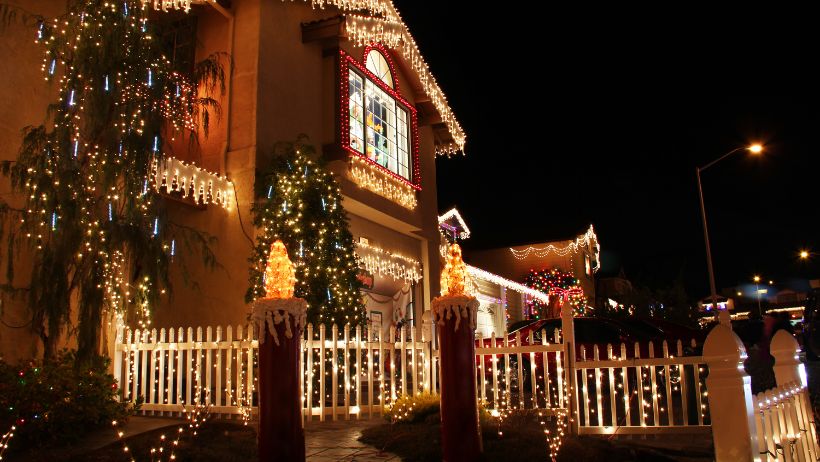
Holiday Decor | Why Board Members Need to Understand the Difference Between Religious and Secular Displays
Rembaum’s Association Roundup | Jeffrey A. Rembaum, Esq., BCS | Visit HERE
If your community association installs a holiday display, is that holiday display considered religious or secular? Are Christmas trees, menorahs, Nativity scenes, or the Kikombe cha Umoja (the Unity Cup used during Kwanzaa celebrations) considered religious or secular? How can you tell the difference? Why is the difference so very important to understand? The reason it is important to understand the difference between a religious versus a secular display is that if your association does have a religious display, and a member makes a request to have a holiday display for their religion too, the association must honor the request in order to avoid a claim of religious discrimination. But, if the holiday display is secular, such obligation does not exist.