
1200 Park Central Blvd. South, Pompano Beach, FL 33064
9121 North Military Trail, Suite 200, Palm Beach Gardens, FL 33410
855 E SR 434., Suite 2209, Winter Springs (Orlando area), FL 32708
1211 North Westshore Blvd., Suite 409 Tampa, FL 33607
Offices in Miami-Dade (by appointment)
Reach any office: 800.974.0680

1200 Park Central Blvd. S., Pompano Bch, FL 33064
9121 N. Military Trail, Ste. 200, Palm Bch Gdns, FL 33410
855 E SR 434., Suite 2209, Winter Springs (Orlando area), FL 32708
1211 N. Westshore Blvd., Ste. 409, Tampa, FL 33607
Offices in Miami-Dade (by appointment)
Reach any office: 800.974.0680

Importance of Having Strong Financial Controls and Policies

Rembaum’s Association Roundup | Jeffrey A. Rembaum, Esq., BCS | Visit HERE

Importance of Having Strong Financial Controls and Policies

Florida’s community associations operate as complex financial and administrative organizations responsible for managing significant budgets, often in the millions of dollars; maintaining shared property; and protecting the financial interests of the owners. With this responsibility comes a board’s fiduciary duty to ensure that financial operations are transparent, accountable, and safeguarded against misuse. In today’s environment where associations face rising costs, increased owner scrutiny, and growing exposure to fraud risks, the need for strong financial policies and controls has never been more important. These four tools form the foundation of responsible financial governance:

i.   A fraud response plan
ii.  A refundable deposit return policy
iii. A conservative reserve investment policy
iv. 
Internal control procedures that guide how the association handles money, assets, and decision-making.

These tools are not merely administrative “housekeeping” items; they are essential safeguards that protect the association’s finances, support the board’s fiduciary obligations, and reinforce trust within the community.

Read the full article HERE

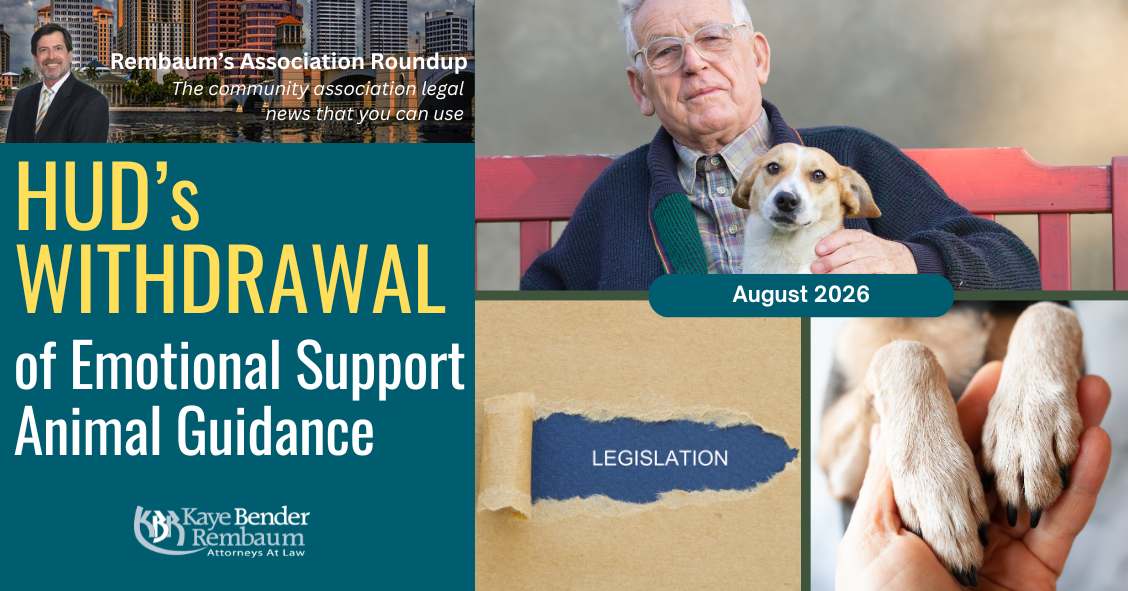
HUD’s Withdrawal of Emotional Support Animal Guidance

Rembaum’s Association Roundup | Jeffrey A. Rembaum, Esq., BCS | Visit HERE

HUD’s Withdrawal of Emotional Support Animal Guidance

For years condominium and homeowners’ associations confronting requests for emotional support animals (ESAs) operated under a relatively well-defined framework established by the U.S. Department of Housing and Urban Development (HUD). The agency’s 2020 guidance, Assessing a Person’s Request to Have an Animal as a Reasonable Accommodation Under the Fair Housing Act, became the primary roadmap for evaluating ESA requests and was frequently cited by attorneys, housing providers, administrative agencies, and courts.

That landscape changed dramatically in May 2026 when HUD’s Office of Fair Housing and Equal Opportunity (FHEO) formally withdrew the 2020 guidance and announced a significant shift in enforcement priorities. At roughly the same time, HUD withdrew numerous prior guidance documents and advisory materials, explaining that guidance documents should not be treated as binding law and should not impose compliance obligations beyond those found in statutes, regulations, and binding judicial precedent.

Read the full article HERE

Understanding Responsibility for Hurricane Protection Removal and Reinstallation Under Florida’s Condominium Act

Rembaum’s Association Roundup | Jeffrey A. Rembaum, Esq., BCS | Visit HERE

Understanding Responsibility for Hurricane Protection Removal and Reinstallation Under Florida’s Condominium Act

As I write this, Florida’s hurricane season is only a few days away. Not too long ago the Florida legislature amended Section 718.113(5)(d) of the Florida Statutes, and the change has significant financial implications for condominium associations and unit owners. This statute now directly addresses who must pay for the removal and reinstallation of hurricane protection such as shutters, impact windows, doors, and similar systems when that removal is necessary for the association to perform work on the common elements. This article addresses both who pays for the removal and reinstallation and who performs the work to do so.

The relevant statute provides that unless the declaration of condominium expressly provides otherwise, a unit owner is not responsible for the cost of removing or reinstalling hurricane protection when the association must temporarily remove it to complete maintenance, repair, or replacement of condominium property for which the association is responsible. This means that the default rule under the amended statute is that the association bears the cost of removal and reinstallation of hurricane protection. This could be a major shift for many communities, especially those with older declarations that never contemplated modern hurricane protection systems. Removal and reinstallation can be very expensive, particularly for impact-rated shutters and windows, and the cost can multiply quickly during large-scale projects such as concrete restoration, painting, balcony work, or window replacement.

Read the full article HERE

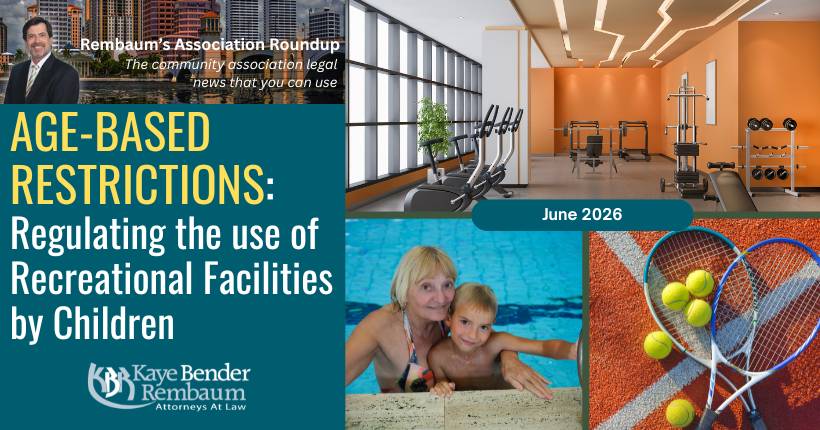
Age-Based Restrictions – Regulating the Use of Recreational Facilities by Children

Rembaum’s Association Roundup | Jeffrey A. Rembaum, Esq., BCS | Visit HERE

Age-Based Restrictions – Regulating the Use of Recreational Facilities by Children

The Fair Housing Act, Title VIII of the Civil Rights Act of 1968 (which has been amended and expanded over the years), prohibits discrimination in housing on the basis of race, color, national origin, religion, sex, familial status, and disability. There are also various state and local regulations that address housing discrimination. While most community associations are aware of and avoid discriminatory housing practices for most protected classes, some community associations struggle with balancing how to steer clear of discrimination on the basis of “familial status” while still addressing common concerns and issues that children can create in a community. The first part of this article addresses communities that are NOT Housing for Older Persons (meaning not 55 and older) communities while 55 years of age and older communities are addressed toward the end.

Discrimination on the basis of “familial status” includes discrimination against children under the age of 18 living with parents or legal custodians, pregnant women, and people securing custody of children under the age of 18. In addition to prohibiting familial status discrimination as to occupancy of a dwelling, the Fair Housing Act’s familial status discrimination prohibition extends to the use of the association’s recreational facilities, including for example, the community clubhouse, swimming pool, hot tub, and fitness center.

Read the full article HERE

Audio and Video Recording in Community Associations

Rembaum’s Association Roundup | Jeffrey A. Rembaum, Esq., BCS | Visit HERE

Audio and Video Recording in Community Associations

Community associations increasingly rely on surveillance technology to enhance safety and protect property. Cameras with imbedded microphones are everywhere these days. As systems become more sophisticated, many boards are considering or are already using audio-enabled cameras in common areas. However, in Florida, recording spoken conversations raises significant legal considerations. This is especially true in areas where a reasonable person would think their conversations are private. Associations must navigate stringent consent laws, privacy expectations, and specific notification requirements to remain compliant and avoid liability. This article summarizes Florida’s legal framework governing audio recordings and outlines best practices for boards seeking to implement or update their surveillance programs.

Florida is a two-party consent state, meaning that all parties to a private conversation must consent before they can legally be recorded. This rule applies to in-person, telephone, and electronic communications. Florida Statute §934.03(1)(d) is explicit and specifically states: “It is lawful…for a person to intercept a wire, oral, or electronic communication when all of the parties to the communication have given prior consent.” Because audio recording captures oral communication, compliance with this statute is essential. Failure to obtain proper consent can expose the association to civil and criminal liability…

Read the full article HERE

Beauty Is in the Eye of the Beholder, or Is It?

Rembaum’s Association Roundup | Jeffrey A. Rembaum, Esq., BCS | Visit HERE

Legal Considerations in Association Landscaping Decisions

It is often said that beauty is in the eye of the beholder, and nowhere is this more evident than in the realm of community landscaping. Among the many benefits of residing within a community association is the expectation of consistently maintained and harmonious landscaping throughout the property. But, when does a change in common area/element landscaping become a material alteration requiring a vote of the membership?

As a general rule for a Florida condominium association, pursuant to §718.113 Fla. Stat., material alterations or substantial additions to condominium common elements require approval by 75 percent of total voting interests unless the declaration of condominium dictates a different procedure. But, as applied to a Florida homeowners’ association, the outcome is diametrically opposed because material alteration decisions are left to the board unless otherwise required by the governing documents.

Read the full article HERE

Why Timing and Experience Matter: Lessons from a Recent Appellate Case

Rembaum’s Association Roundup | Jeffrey A. Rembaum, Esq., BCS | Visit HERE

A recent appellate case, Whitehall at Bal Harbour Condominium Ass’n, Inc. v. Raviv, case No. 3D24-2031 (3d DCA, Jan 21, 2026), is a great reminder that in litigation, silence is not golden and can lead to a courtroom disaster. Legal disputes often turn on complex facts, nuanced statutes, and competing interpretations of precedent. But sometimes, the decisive factor is far simpler, such as whether a party raised its legal argument(s) at the right time.

This recent decision is a textbook example of how failing to timely assert a procedural objection can effectively forfeit it, and how that forfeiture can shape the outcome of an entire appeal, leading to a windfall victory for the other side. This case is much more than just a condominium dispute. It is a cautionary tale about litigation strategy, procedural diligence, and the indispensable value of retaining skilled litigation counsel.

The underlying dispute began as a typical conflict between a condominium association (Whitehall) and a…

Read the full article HERE

Does the Association Need to Exercise Self-Help Options Before Taking Legal Action?

Rembaum’s Association Roundup | Jeffrey A. Rembaum, Esq., BCS | Visit HERE

An Ever-Changing Situation

In two previous articles – “Violation Remedies: Self-Help vs. Injunction | Which to Use” published in June 2022 and “Is It Time to Consider Removing an Association’s Right of Self-Help to Cure an Owner’s Violation from the Declaration?” published in November 2023 – the Roundup reported on appellate cases addressing the right of homeowners’ associations to seek an injunction against an owner for violations of the declaration as compared against the need to first seek a self-help remedy when also authorized by the declaration. Both articles discussed recent appellate cases from Florida’s 2nd District Court of Appeal (DCA) and Florida’s 6th DCA. These cases held, in short, that if the declaration provides that an association may seek an injunction for a court order against a noncomplying owner and also includes the association’s right of self-help to cure the violation, the remedy of self-help must be employed before the association can seek an injunction ordering the noncomplying owner to cure the violation.

For example, if an owner fails to maintain their yard and the declaration provides the association with the remedies of self-help and seeking a court ordered injunction to compel the owner to cure the violation, both the 2nd DCA and 6th DCA held that the association must at least try…

Read the full article HERE

Posting Official Records on the Association’s Website and Electronic Meeting Posting and Retention Requirements

Rembaum’s Association Roundup | Jeffrey A. Rembaum, Esq., BCS | Visit HERE

The purpose of this Roundup article is to clarify which condominium association official records must be posted to the association’s website. This is due to the January 1, 2026, requirement set out in §718.111(12)(g), Florida Statutes, which requires that all condominium associations with 25 or more units that do not contain timeshare units have a password-protected website (or downloadable through an app on a mobile device) upon which to post certain official records. This article will also address a few distinctions as compared to the website and posting requirements for a homeowners’ association governed under Chapter 720, Florida Statutes.

The general requirements for condominium associations are as follows:

Read the full article HERE

Adopting Electronic Voting in Florida

Rembaum’s Association Roundup | Jeffrey A. Rembaum, Esq., BCS | Visit HERE

The Statutory Similarities and Differences Applicable to Condominium, Cooperative and Homeowners’ Associations

Electronic voting continues to become an increasingly attractive option for community associations. The benefits of electronic voting are many and include the following: (i) allowing members to cast their votes from an electronic device anywhere with an internet connection; (ii) helping associations achieve quorum requirements because an electronic vote counts as the member being in attendance at the meeting; (iii) automating the counting and collection of votes thereby reducing the potential for errors associated with manual counting ballots; and (iv) saving associations money by reducing costs associated with the cost of printing and mailing of paper ballots and associated paperwork.

Despite the many benefits of electronic voting, many associations still insist on voting the old-fashioned way and are reluctant to adopt electronic voting. However, as further discussed below, adopting electronic voting is not a complicated endeavor.

So, how can an association adopt electronic voting? In short, at a properly noticed board meeting, the board of directors (the board) of the association must…

Read the full article HERE