1200 Park Central Blvd. South, Pompano Beach, FL 33064
9121 North Military Trail, Suite 200, Palm Beach Gardens, FL 33410
855 E SR 434., Suite 2209, Winter Springs (Orlando area), FL 32708
1211 North Westshore Blvd., Suite 409 Tampa, FL 33607
Offices in Miami-Dade (by appointment)
Reach any office: 800.974.0680

1200 Park Central Blvd. S., Pompano Bch, FL 33064
9121 N. Military Trail, Ste. 200, Palm Bch Gdns, FL 33410
855 E SR 434., Suite 2209, Winter Springs (Orlando area), FL 32708
1211 N. Westshore Blvd., Ste. 409, Tampa, FL 33607
Offices in Miami-Dade (by appointment)
Reach any office: 800.974.0680

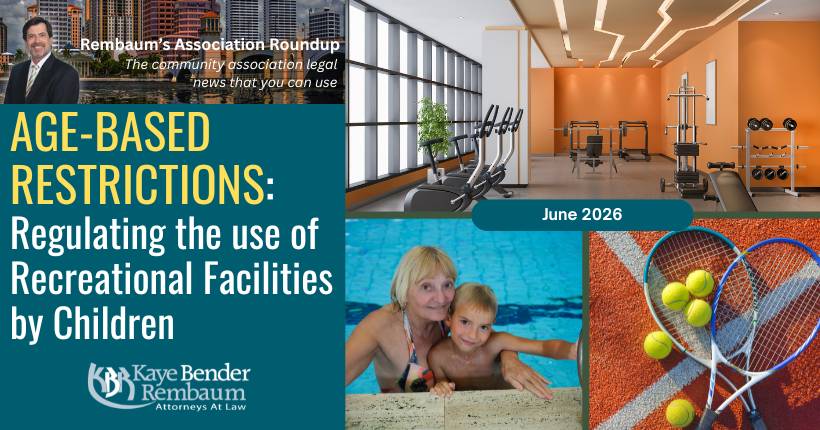
Age-Based Restrictions – Regulating the Use of Recreational Facilities by Children

Rembaum’s Association Roundup | Jeffrey A. Rembaum, Esq., BCS | Visit HERE

Age-Based Restrictions – Regulating the Use of Recreational Facilities by Children

The Fair Housing Act, Title VIII of the Civil Rights Act of 1968 (which has been amended and expanded over the years), prohibits discrimination in housing on the basis of race, color, national origin, religion, sex, familial status, and disability. There are also various state and local regulations that address housing discrimination. While most community associations are aware of and avoid discriminatory housing practices for most protected classes, some community associations struggle with balancing how to steer clear of discrimination on the basis of “familial status” while still addressing common concerns and issues that children can create in a community. The first part of this article addresses communities that are NOT Housing for Older Persons (meaning not 55 and older) communities while 55 years of age and older communities are addressed toward the end.

Discrimination on the basis of “familial status” includes discrimination against children under the age of 18 living with parents or legal custodians, pregnant women, and people securing custody of children under the age of 18. In addition to prohibiting familial status discrimination as to occupancy of a dwelling, the Fair Housing Act’s familial status discrimination prohibition extends to the use of the association’s recreational facilities, including for example, the community clubhouse, swimming pool, hot tub, and fitness center.

Read the full article HERE
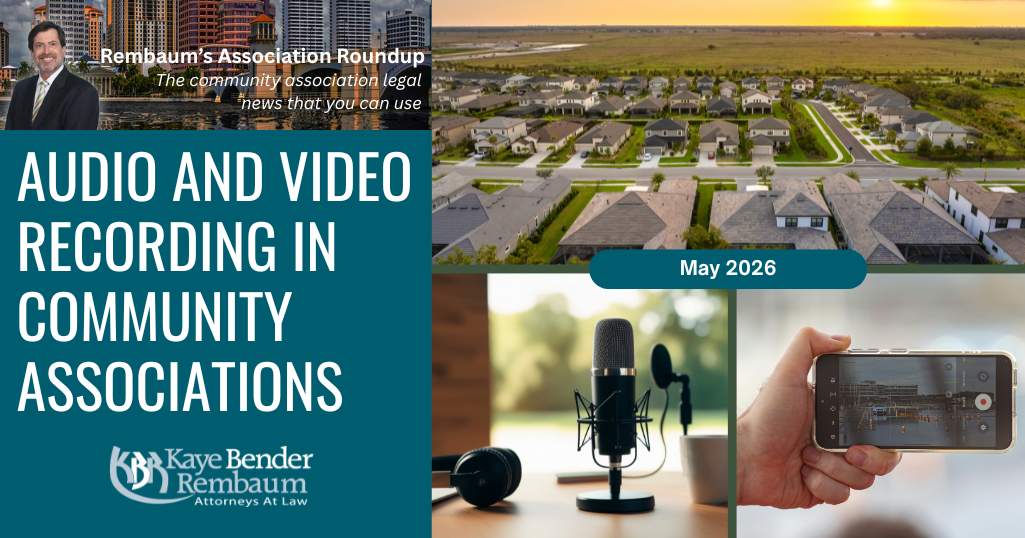
Audio and Video Recording in Community Associations

Rembaum’s Association Roundup | Jeffrey A. Rembaum, Esq., BCS | Visit HERE

Audio and Video Recording in Community Associations

Community associations increasingly rely on surveillance technology to enhance safety and protect property. Cameras with imbedded microphones are everywhere these days. As systems become more sophisticated, many boards are considering or are already using audio-enabled cameras in common areas. However, in Florida, recording spoken conversations raises significant legal considerations. This is especially true in areas where a reasonable person would think their conversations are private. Associations must navigate stringent consent laws, privacy expectations, and specific notification requirements to remain compliant and avoid liability. This article summarizes Florida’s legal framework governing audio recordings and outlines best practices for boards seeking to implement or update their surveillance programs.

Florida is a two-party consent state, meaning that all parties to a private conversation must consent before they can legally be recorded. This rule applies to in-person, telephone, and electronic communications. Florida Statute §934.03(1)(d) is explicit and specifically states: “It is lawful…for a person to intercept a wire, oral, or electronic communication when all of the parties to the communication have given prior consent.” Because audio recording captures oral communication, compliance with this statute is essential. Failure to obtain proper consent can expose the association to civil and criminal liability…

Read the full article HERE

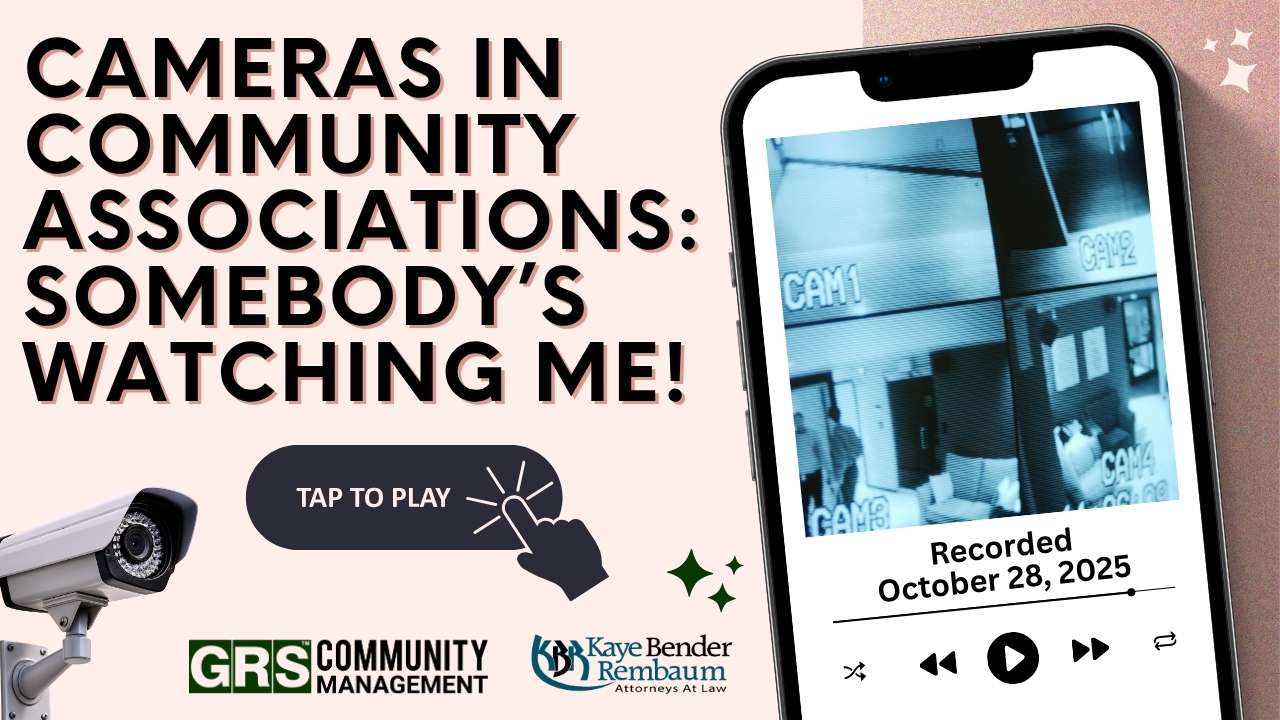
Cameras in Community Associations – Somebody’s Watching Me! | October 28, 2025

*Read Before Viewing* | This recorded video WILL NOT satisfy Florida state certification requirements for Board Members, NOR will this recorded version offer CEUs for CAMS or Board Members. It is for informational purposes only and is not to be considered as legal advice. Should you have any questions, contact your association counsel.

Led by attorney Alan Schwartzseid, BCS. Co-hosted with GRS Community Management, and Courtney Buchan, CAM in attendance.
 
Cameras (including drones) have become prevalent in Florida community associations, especially after the Florida legislature adopted statutes protecting multi-family communities from certain negligent security claims if cameras (among other proactive measures) are added. Lack of understanding regarding the limitations of this protection, the legal requirements and prohibitions pertaining to video and audio recording in Florida law community associations, and various other aspects of those recordings, can be severely damaging to community associations. Participants in this course will learn about common pitfalls in installation, maintenance, and monitoring of cameras in community associations.